From Wikipedia, the free encyclopedia
The terms
Muslim world and
Islamic world commonly refer to the unified Islamic community (
Ummah), consisting of all those who adhere to the religion of
Islam,
[1] or to societies where Islam is practiced.
[2][3] In a modern
geopolitical sense, these terms refer to
countries where Islam is widespread, although there are no agreed criteria for inclusion.
[4][3] Some scholars and commentators have criticised the term 'Muslim/Islamic world' and its derivative terms 'Muslim/Islamic country' as "simplistic" and "binary", since no state has a religiously homogeneous population (e.g.
Egypt's citizens are c. 10%
Christian), and in absolute numbers, there are sometimes fewer Muslims living in countries where they make up the majority than in countries where they form a minority.
[5][6][7] Hence, the term
Muslim-majority countries is often preferred in literature.
[8]
The history of the Muslim world spans about 1400 years and includes a variety of socio-political developments, as well as advances in the arts, science, philosophy, and technology, particularly during the
Islamic Golden Age.
[citation needed] All
Muslims look for guidance to the
Quran and believe in the prophetic mission of
Muhammad,
[citation needed] but disagreements on other matters have led to appearance of different religious
schools and branches within Islam. In the modern era, most of the Muslim world came under influence or
colonial domination of European powers. The nation states that emerged in the post-colonial era have adopted a variety of political and economic models, and they have been affected by secular and as well as religious trends.
[citation needed]
As of 2013, the combined
GDP (nominal) of 49 Muslim majority countries was US$ 5.7 trillion,
[9] As of 2016, they contributed 8% of the world's total.
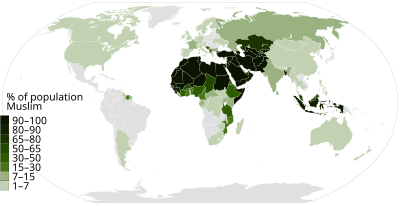
[10] As of 2015, 1.8 billion or about 24.1% of the world population are Muslims.
[11] By the percentage of the total population in a region considering themselves Muslim, 91% in the
Middle East-
North Africa (
MENA),
[12] 89% in
Central Asia,
[13] 40% in
Southeast Asia,
[14] 31% in
South Asia,
[15][16] 30% in
Sub-Saharan Africa,
[17] 25% in
Asia–
Oceania,
[18]around 6% in
Europe,
[19] and 1% in
the Americas.
[20][21][22][23]